Monday, April 9, 2012

What If Pete Rose Had Cut a Deal?


February 21, 1989: Pete Rose, baseball's all-time hits leader, now the manager of the Cincinnati Reds, is confronted by Commissioner A. Bartlett "Bart" Giamatti with evidence that he bet on baseball. Rose comes clean, about his gambling, and also about his tax issues.

February 22, 1989: Giamatti announces that Rose has been indefinitely suspended from baseball, and that he can apply for reinstatement in 3 years -- in February 1992. This would mean that, in the Baseball Hall of Fame election of January 1992, which would have been his first time eligible, he would not be eligible.

August 24, 1989: Rose pleads guilty to two felony counts of filing false income tax returns. He will serve five months in prison and is fined $50,000.

September 1, 1989: Giamatti has a heart attack, but lives. He recovers in time to attend the 1989 World Series.

Is there any such thing as a "mild heart attack"? As basketball legend Bill Walton -- whose career ended around this time, due to yet another foot/ankle surgery -- taught us, "Minor surgery is what they do to somebody else."

October 17, 1989: An earthquake strikes San Francisco during the World Series between the San Francisco Giants and the cross-bay Oakland Athletics. Giamatti suspends the Series for 10 days, and is greatly admired for handling the situation, just as he was for giving Rose, and the game, a fair shake.

August 8, 1990: Rose is released from federal prison in Marion, Illinois. He begins the second part of his sentence, consisting of 1,000 hours of community service at Cincinnati inner-city schools.

January 7, 1992: Tom Seaver and Rollie Fingers are elected to the Baseball Hall of Fame. Rose, ineligible because of his ban from baseball, receives 62 write-in votes.

January 5, 1993: Reggie Jackson and the newly-reinstated Pete Rose are elected to the Hall of Fame. The New York Yankees announce that Jackson's Number 44 will be retired in a ceremony that summer. The Cincinnati Reds announce the same for Rose's Number 14. Lou Piniella, who had been hired to replace Rose as Reds' manager, has moved on to the Seattle Mariners. Rose's former teammate, Tony Perez, is named manager, and, with Giamatti's permission, hires Rose as his bench coach.

May 19, 1993: Reds owner Marge Schott is unhappy with Perez's managing, but Rose intervenes, and asks her to let Perez manage at least one full season. She says no. Then Rose puts the squeeze on her: "I've already told the Commissioner everything I know about myself. If Perez goes, I go, too, and not only will you have driven away the most popular athlete in Cincinnati history, but I'll tell Giamatti everything I know about you." Knowing how much she has to lose, Schott refuses to call Rose's bluff, and keeps Perez on.

January 2, 1994: The Major League Baseball owners vote to re-elect Giamatti to a new five-year term as Commissioner.

August 11, 1994: Giamatti and Players' Association Director Donald Fehr negotiate a last-minute deal that avoids a players' strike.

August 17, 1994: Just 6 games out of first place in the National League Eastern Division, the Atlanta Braves are dealt a serious blow. Starting pitcher Greg Maddux injures his wrist while fielding a bunt by Roberto Kelly of the Cincinnati Reds. Maddux is never the same pitcher again, and retired after the 1999 season.

September 5, 1994: Cal Ripken Jr. is hit in the back by a pitch in the first game of a Labor Day doubleheader. He has to miss the second game, ending his consecutive-games-played streak at 2,097. He falls just 33 short of Lou Gehrig's all-time record.

September 11, 1994: The Montreal Expos clinch the NL East, winning it for the first time since 1981 -- for the first time ever in a season not shortened by a strike, finishing 10 games ahead of the Braves. The Expos have become a sensation, the way they had been in 1980 and '81, when they had their previous best team ever. Despite the inadequacies of the Olympic Stadium, sellout crowds of 43,000 seem to come out every night. Fans wave flags, some the red Maple Leaf of Canada, some the blue Fleurdelisé of the Province of Quebec. A larger version of the Maple Leaf flag has been draped over the left-field fence, and a large Fleurdelisé over the right-field fence.

September 12, 1994: The Liberal Party wins the Provincial election. The leader of the separatist Parti Quebecois, Jacques Parizeau, had promises a referendum on Quebec's separation from Canada in the event of a PQ victory. But with Quebecois (or "Quebeckers") energized by the Expos, who are threatening to follow the Toronto Blue Jays to make this the 3rd straight year a Canadian team is in (and wins) the World Series, there seems to be no desire for separation. Parizeau soon resigns as PQ Leader, and Liberal Leader Daniel Johnson Jr. (whose father and brother also held the office) remains as Premier of Quebec (the equivalent of the Governor of an American State, but with more power).

October 2, 1994: The baseball season that nearly ended on August 12 ends as scheduled. In the National League, the Montreal Expos win the Eastern Division by 10 games over the Braves. The Reds, with manager Tony Perez making the most of his second chance, win the newly-created NL Central Division, edging the Houston Astros by 2 games. The Astros win the first-ever NL Wild Card. In the Western Division, the San Francisco Giants, led by Matt Williams' 58 home runs for a new NL record, beat their arch-rivals, the Los Angeles Dodgers, by 3 games. Tony Gwynn of the San Diego Padres bats .402, becoming the first player since Ted Williams in 1941 to bat .400 or more -- the first NLer since Bill Terry in 1930.

In the American League, the New York Yankees win the East by 8 games over the Baltimore Orioles. Lou Piniella's Seattle Mariners reach their first postseason by taking the West by 3 games over the Texas Rangers, led by Ken Griffey Jr.'s 56 homers, most in the AL since Roger Maris' record 61 in 1961. The Central Division has the most interesting race. The Chicago White Sox, defending Division champions but without a Pennant since 1959, beat the Cleveland Indians, without a Pennant since 1954 and in their first race since 1959 (when they were edged by the White Sox), by just 1 game; the Kansas City Royals, 1985 World Champs but out of the Playoffs since, finish just 2 back. The Indians do win the first-ever AL Wild Card.

October 10, 1994: The first-ever Division Series -- not counting the strike-forced setup of 1981 -- are done. In this best-3-out-of-5 setup, the Yankees beat the Indians in 4 games, the White Sox sweep the Mariners, the Expos sweep the Astros in what Montreal Gazette columnist Jack Todd jokes is "the first postseason baseball series played entirely outside the United States," and the Giants win a 5-game thriller with the Reds. Again, Pete Rose has to intervene with owner Marge Schott to keep Tony Perez, who, after all, did manage them to the postseason.

October 19, 1994: The Pennants have been won. For the first time in 35 years, a Pennant flies over Chicago, as the White Sox beat the Yankees in 6. Yankee owner George Steinbrenner is determined to get a better reliever than Steve Howe and Bob Wickman. And for the 3rd year in a row, a Canadian team will be in the World Series, as the Expos win their first-ever Pennant, thanks to Mike Lansing's walkoff homer off Dave Burba in the bottom of the 10th inning in Game 6 at the Olympic Stadium.

October 22, 1994: Game 1 is held at the Olympic Stadium in Montreal. Prime Minister Jean Chretien throws out the first ball. Pedro Martinez goes the distance and Larry Walker provides the difference with a home run off Jack McDowell. Expos 2, White Sox 0. Expos lead, 1 game to 0.

October 23, 1994: Game 2 at the Big O. Gary Carter throws out the first ball. Ken Hill falls apart in the 3rd inning, and Robin Ventura and Frank Thomas hit back-to-back home runs, the Big Hurt's homer challenging Willie Stargell in 1973 and Darryl Strawberry in 1988 for the title of longest ever in the stadium. White Sox 9, Expos 1. Series tied, 1 game to 1.

October 25, 1994: Game 3 at the new Comiskey Park, the first World Series game played in Chicago since October 8, 1959 at the old Comiskey Park. Luis Aparicio, the star of those '59 "Go-Go Sox," throws out the first ball. Wilson Alvarez and Jeff Fassero both throw goose eggs for 7 innings. But Mel Rojas implodes, and the Sox -- known in a previous era as the South Side Hit Men -- whack him. White Sox 6, Expos 0. White Sox lead, 2 games to 1.

October 26, 1994: Game 4 at Comiskey. Billy Pierce, another member of the '59 Pale Hose, throws out the first ball. Pedro comes to the rescue, dazzling everyone with a 2-hit shutout that eases the strain on the Montreal bullpen. Marquis Grissom takes Jason Bere deep twice, becoming the first Chicago player to hit 2 homers in a World Series game since Ted Kluszewski in Game 1 in '59. Expos 5, White Sox 0. Series tied, 2 games to 2.

October 27, 1994: Game 5 at Comiskey. Ron Kittle, Rookie of the Year with the AL West Champion ChiSox of 1983, throws out the first ball. McDowell is very careful with the rest, and while Hill also pitches well, single runs in the 2nd, 5th and 6 doom him. White Sox 3, Expos 1. The White Sox lead, 3 games to 2, and need to take just 1 out of 2 games in Montreal to become the first Chicago team to win a World Series since the White Sox of 1917 -- 77 years ago.

October 29, 1994: Game 6 at the Olympic Stadium. Duke Snider, the Hall-of-Famer who played for the Brooklyn Dodgers, and for their Montreal Royals farm team before that, and later broadcast for the Expos, throws out the first ball. Fassero finds his form, and homers by Walker and Grissom make the difference. John Wetteland stops a Chicago rally in the top of the 9th. Expos 5, White Sox 4. The Series is tied at 3 games apiece. Tomorrow, it will be pour tous les marbres -- for all the marbles.

October 30, 1994: Game 7 of the World Series at the Olympic Stadium. Claude Raymond, who grew up playing baseball on the sandlots of Montreal, including Jarry Park where the team's first ballpark was built, and later pitched there for the Expos before becoming their preeminent French-station broadcaster, throws out the first ball. The Francophone Montrealers get a huge lift out of this, but it is the Spanish-speakers who dominate this game. Pedro Martinez and Wilson Alvarez both go 8 strong, and home runs are hit by Julio Franco of the White Sox and Wil Cordero of the Expos.

The games goes to the 9th, tied 2-2. Pedro hits Frank Thomas with a pitch. Thomas points at him, saying it was on purpose. Sox shortstop Ozzie Guillen, not previously known as a hothead, begins screaming at the dugout, calling Pedro every name in the Spanish book. Pedro points at his head, and then points at Ozzie, as if to say, "You want to be next?" Home plate umpire Darryl Cousins has had enough: In the 9th inning of Game 7 of the World Series, he throws the incumbent pitcher out of the game.

Expo fans roar with rage, and the field is littered with debris. Public-address announcements are made in English and French, demanding that the fans stop, or the game will be forfeited to the visiting White Sox. (As home team, the Expos are responsible for crowd control.) The fusillade, or the barrage (pick your French-inspired word of choice) does not stop.

Finally, a familiar voice comes over the P.A. It is the voice of the most beloved person in the history of the Province of Quebec, Canadiens legend Maurice Richard. The Rocket implores the crowd, in French, to stop, reminding them of the riot, supposedly on his behalf, that shamed the city in 1955, which may have cost the Canadiens the Stanley Cup. The crowd listens, and stops. John Wetteland comes out of the bullpen, and gets the last 3 outs.

In the bottom of the 9th, with the game still tied, Roberto Hernandez comes on in relief of Alvarez. Moises Alou leads off by drawing a walk. Larry Walker singles to center. Cordero pops up. One out, with the run that will win the World Series at 2nd base. The batter is Lenny Webster, and he singles to left field. Tim Raines throws to the plate, Alou slides in... Safe. Expos 3, White Sox 2. For the first time ever, the Montreal Expos are World Champions.

November 1, 1994: Over 2 million people turn out for the Expos' championship parade down Rue Ste-Catherine. Premier Johnson announces that he will ask the Provincial government, the National Assembly, to help the team build a new ballpark in the mold of Baltimore's Camden Yards and Cleveland's Jacobs Field. In spite of the Expos' success, reliever John Wetteland's contract is set to run out in another year, and the Expos accept a trade that sends him to the Yankees.

October 28, 1995: The first-ever all-Ohio World Series ends as the Cleveland Indians win their first Series in 47 years, defeating the Cincinnati Reds 1-0 in Game 6. The Indians had beaten the Boston Red Sox and Seattle Mariners to reach the Series, while the Reds had beaten the Los Angeles Dodgers and the surprising 3rd-year Colorado Rockies (NL Wild Card winners, who had beaten the Atlanta Braves, NL East Champions but weakened as a result of Greg Maddux not finding his control after his injury).

April 20, 1996: In a deal partially brokered by Reds legend Pete Rose and baseball Commissioner Bart Giamatti, Marge Schott sells the Reds to local businessman Carl Lindner. Schott makes a substantial profit, and in return for going quietly, things that would embarrass her will be kept quiet. This, after she herself couldn't keep quiet after a shocking interview earlier in the month.

October 26, 1996: With former Expo John Wetteland saving all 4 Yankee wins, the New York Yankees win their 23rd World Championship, defeating the Expos 3-2 at Yankee Stadium. The Yankees, desperate for a relief ace, had traded a few minor league prospects and a significant amount of cash to the Expos. Despite having Mel Rojas as their new closer, the Expos regained the NL East title from the fading Braves, and beat the San Diego Padres in an NLCS billed as "Canada vs. Mexico."

October 26, 1997: The Cleveland Indians, winners of 2 World Series in their first 94 seasons, have now won 2 of the last 3, holding off the NL (and NL East) Champion Florida Marlins, 3-1 in Game 7 to take the Series.

I'll finish this piece at a later date. How would Giamatti have handled the steroid situation?

April 1, 1998: Labatt Park opens in downtown Montreal, a couple of blocks from Windsor Station and the Molson Centre (now the Bell Centre). The Expos lose to the Pittsburgh Pirates, 4-0, but now they have a real ballpark, not that flying saucer masquerading as one. The recently retired Expo legend Andre Dawson throws out the ceremonial first ball. The Expos will make it 3 NL East titles in 5 years, but will not win the Pennant, as the Yankees sweep the Padres in 4 games.

October 31, 1998: Baseball Commissioner Bart Giamatti, citing his health, announces he will not seek another term.

January 4, 1999: Leonard Coleman, President of the National League, is elected the first black Commissioner of Baseball.

October 24, 1999: The Major League Baseball All-Century Team, chosen by fans' ballots sponsored by MasterCard, is introduced before Game 2 of the World Series. This is the first Subway Series in 43 years, as the AL East Champion New York Yankees defeated the AL West Champion Texas Rangers and Wild Card winner Boston Red Sox to get there, while the NL East Champion New York Mets defeated the NL West Champion Arizona Diamondbacks and the Wild Card winner Atlanta Braves to do so. The ceremony is at Shea Stadium. Great cheers are given to former Yankee player, and Yankee and Met manager, Yogi Berra, while respectful cheers are given to the memories of deceased Yankee legends Babe Ruth, Lou Gehrig, Joe DiMaggio and Mickey Mantle. Late ballots by Met fans allowed Tom Seaver to make the team, edging out current Yankee pitcher Roger Clemens. One player, however, gets booed: Pete Rose, while loved in many cities, is hated at Shea because of his suspension for betting on baseball and his fight with the Mets in the 1973 Playoffs. The Yankees go on to sweep the Mets in the Series.

February 27, 2005: Paul Giamatti is among the nominees for the Academy Award for Best Actor, for his role in Sideways. He does not win: Jamie Foxx does, for playing Ray Charles in Ray. But Giamatti's father, former Baseball Commissioner Bart Giamatti, lives to see it.

August 7, 2005: A. Bartlett Giamatti, Commissioner of Baseball from 1989 to 1998, dies at his home on Martha's Vineyard, Massachusetts. He was 67.

Friday, April 6, 2012

Roy Hobbs: The Life Story of a Natural


What if The Natural was a true story?

And by "The Natural," I mean the movie. Not the book. Someday, in my other baseball-themed blog, "Uncle Mike's Musings," I play to do a Top 5 Reasons You Can't Blame Bernard Malamud for Having Roy Hobbs Strike Out. And a Top 5 Reasons You Can't Blame the Filmmakers for Changing the Ending of The Natural.

The following is based on the movie, and is mainly my own speculations of what Roy's life was like from birth to 1939, aside from those few scenes of his boyhood, that fateful couple of days in 1923 leading to the shooting in the Chicago hotel, and those amazing 4 months with the 1939 New York Knights, the movie's stand-in for the Giants, even if they were, more or less, competitively analogous to the 1930s "Daffiness Boys" Brooklyn Dodgers.

Imagine Randy Newman's epic score coming up...

Roy Hobbs: The Life Story of a Natural

Youth
Roy Edward Hobbs was born May 11, 1904 in Mitchell, South Dakota. His mother, Louise, died when he was a toddler, and his father Ed, who taught him how to play baseball, died when Roy was 13. Ed suffered a heart attack under a tree on the family farm.

That night, a thunderstorm resulted in a lightning bolt striking that tree and splitting it open. Roy chopped some wood from that tree and used to to produce a baseball bat, which he christened "Wonderboy."

Unexpected Detours
As a teenager, Roy pitched eight no-hitters in high school and American Legion baseball, and was perhaps the greatest hitting prospect the State of South Dakota has ever produced. He also began a relationship with Iris Gaines, who lived at the next farm over.

In 1923, at age 19, Roy received a tryout offer from the Chicago Cubs. He told Iris about it, proposed marriage to her, and they spent the night together.

Taking the train to Chicago, he met Walter Wambold, the Philadelphia Athletics slugger known as "The Whammer"; Max Mercy, nationally-syndicated sports columnist; and Harriet Bird, a woman later discovered to have shot and killed two famous athletes, who had, at this point, set her sights on the Whammer.

A bet between Mercy and Sam Simpson, a former big-league catcher who had scouted Roy for the Cubs, resulted in a faceoff between Roy and Wambold in a field next to a county fair in Nebraska, where the train had made a refueling stop, and Wambold had shown off his hitting stroke, while Roy showed his pitching form by throwing baseballs at milk bottles, knocking them over with pinpoint control. When the at-bat took place, Roy struck the Whammer out on three pitches.

Getting onto the train, a kid ran after Roy and asked him his name. Roy answered, and tossed the boy a ball. Roy would never see that ball again, but he would see that boy. (Cue the creepy foreshadowing music!)

Harriet then turned her attention to Roy, and in Chicago, she invited him up to her hotel suite. She shot him, and then killed herself. Because of this shooting, Roy never made it to his tryout, and spent the next two years in and out of hospitals, recovering from his wound.

Unknown to Roy, Iris gave birth to his son, whom she named Edward after Roy's father. He would, like Britain's King Edward VII and Senator Edward M. Kennedy, be nicknamed "Ted."

Roy went on to play for several amateur and minor league teams in the late 1920s and all through the 1930s, but, for years, his weakened physical condition prevented him from playing at a level that would gain a scout's notice.

Return to Baseball
Finally, in 1939, playing in western New York for the Hebron Oilers, he gained a contract with the New York Knights. This team had been known as the New York Giants until first baseman Hal Chase caused a great scandal by "throwing" the 1917 World Series to the Chicago White Sox, a harbinger of the even bigger scandal two years later when the 1919 Series was thrown by the White Sox, who should have known better, to the Cincinnati Reds. The 1917 scandal forced the resignation of Giants manager John McGraw, who left baseball and died a broken man in 1934.

By the mid-1920s, the team, renamed the Knights, had fallen behind both their fellow National Leaguers, the Brooklyn Dodgers, and the American League's New York Yankees, making them the third-most-popular team in New York. This was especially the case after the Yankees, whose slugger George "Babe" Ruth was first said to have borne a physical resemblance to Wambold, then well surpassed Wambold's feats, outdrew the Giants at their home, the Polo Grounds, and affronted Giant management told the Yankees their lease would not be renewed. This was a terrible mistake, as the Yankees built Yankee Stadium, and the loss of Yankee rent nearly forced the Giants/Knights into bankruptcy.

Broadway showman George M. Cohan, long a Giant fan, bought and renamed the team in 1924, and saw Pennants that McGraw's Giants could have won go to other teams: 1918, 1929, 1932, 1935, 1937 and 1938 by the Cubs; 1919, 1922 and 1923 by the Reds; 1920 and 1924 by the Dodgers; 1921, 1925, 1927 and 1933 by the Pittsburgh Pirates; 1926, 1928, 1930, 1931, 1934 and 1936 by the St. Louis Cardinals.

Cohan nearly bankrupted himself building a new home intended to better compete with Yankee Stadium than the bathtub-shaped Polo Grounds. Cohan sold the Knights and Knights Field to the team's manager, Glenn "Pop" Fisher, in 1926, shortly after the ballpark's completion.

Like Roy, Fisher grew up on a farm, and was told by his mother that he should have stayed a farmer. Instead, he grew up to be a baseball player, a first baseman with the 1900s Pittsburgh Pirates, a teammate of Honus Wagner. But after managing the team for a few years, he was unceremoniously fired, and, as manager first of the Philadelphia Phillies and then the Knights, could often be heard, sometimes muttering, sometimes yelling, "I hate losing to the Pie-ritts!"

Fisher didn't want Roy, then 35 years old, telling him, "Mister, you don't start playing ball at your age, you retire." But Philip Banner, a former federal judge to whom Fisher had to sell a stake in the team to keep it afloat during the Great Depression, gave Roy a chance. After an impressive show in batting practice and outhustling starting right fielder Bartolomew "Bump" Bailey, Roy became the team's starting right fielder, a path that became easier after Bailey crashed into the right-field wall to make a catch, hitting his head and suffering a fatal injury.

Bailey's girlfriend was Memo Paris, who also happened to be Fisher's niece. But she was two-timing Bailey with Gus Sands, a well-known gambler with ties to Judge Banner. Sands was one of the reasons Banner left the bench: A crony of President Warren G. Harding, who had appointed him to the federal bench, Banner was found to be crooked during the Administration of President Franklin D. Roosevelt (which was ongoing at this time), and was told there would be no prosecution if he left the bench and found another avocation. The ill financial fortunes of the Knights allowed this.

The purchase agreement between Banner and Fisher stated that, by the end of the 1939 season, if the Knights won a Pennant, Fisher could buy Banner's shares in the team back; if they hadn't, Banner would buy out Fisher, and Fisher, who would be 64 years old by that point, would be out as part-owner and manager, and likely out of the game, with no major league team willing to hire a manager who had gotten to that age without ever managing a Pennant winner.

When Roy defied his age and the predictions of most baseball watchers to become one of the top hitters in the game so soon after his arrival at Knights Field, Banner was concerned that he might come up on the short end of his agreement with Fisher. He enlisted Sands and Memo to help him stop Roy.

Memo seduced Roy, and as their affair move on, his hitting fell into a slump, and so did the team: Once appearing as if they would challenge for the Pennant, the Knights dropped back into the second division.

All the while, Roy had to deal with another distraction: Max Mercy, whose nationally-syndicated column has become bigger than ever, was trying to figure out where he'd seen Roy before. He offered Roy $5,000 -- equal to Roy's annual salary from the Knights and about $80,000 in 2010 money -- for his story. Roy refused, knowing that if the general public knew about Harriet Bird and the Chicago hotel, he'd be finished as a baseball hero.

The combined slump of Roy and the Knights turned around one game in Chicago, at Wrigley Field, the ballpark Roy once thought he would make his own. Iris had her first chance to see Roy play in the majors, and he saw her in the stands. On the next pitch, he hit a drive that shattered the clock on the Wrigley scoreboard.

The next day, he battered Cub pitching for four home runs, only the fifth time that had happened in the major leagues to that point. After the game, Roy and Iris caught up with each other at a nearby coffee shop, each explaining what had happened to the other. Iris told Roy she had a son. She did not say that Ted was also Roy's son, only that "His father lives in New York."

The 1939 Pennant Push: Shooting Out the Lights
Coming back from Chicago, Roy kept hitting the ball rather than Memo's apartment, and the Knights went on a tear. With three games left in the regular season, they were three games ahead of the Pirates, the very team that had once wronged Fisher. They needed to win just one more game to win the Pennant.

But at a party hosted by Memo, Roy fell ill and had to be rushed to the hospital. He was poisoned, and his stomach was pumped. Only then, despite all his surgeries in 1923, '24 and '25, was the silver bullet fired into him by Harriet Bird found and removed. He was told that the lining of his stomach was so badly damaged that any further attempt to play baseball would cause internal bleeding, and he could die.

The Knights lost the next three games. A Playoff for the Pennant was necessary. Roy was visited in the hospital by Memo, who told him he mustn't play. He was visited by Judge Banner, who offered him $20,000 -- about $320,000 in 2010 money -- to play his usual game in the field, but not to hit the ball at all; in other words, to throw the game and the Pennant. Banner also told Roy that "a key man" had been put on the take as a fail-safe.

Memo and Iris also visited Roy, Memo to tell him that he should take the money, throw the Pennant, and then run away with her somewhere and let the scandal blow over; Iris to tell him that she and Ted would be at the Playoff game.

Roy decided he had to play, and the next day, that memorable October 2, 1939, he went up to Banner's office, where Memo and Sands were waiting, and gave the envelope full of cash back.

"Correct me if I'm wrong, Hobbs," Banner said, "but we had a deal."

"Consider yourself corrected, you fat, corrupt son of a bitch," Roy said. "We were never going to have a deal."

(When the film version of Roy's story was made, the producers wanted to keep a PG rating, so certain scenes, including those of Roy in bed with Iris and Memo, were cut or scaled back, and the profanity significantly reduced, so that the Roy character simply said, "No," not his actual words.)

It was then that Memo, having pulled a gun out of Banner's desk, fired it. Unlike Harriet Bird, however, she couldn't bring herself to try to kill Roy, instead shooting at the floor. Only then did Roy see the similarties between the brunette Harriet, now dead 16 years, and the blonde Memo.

He got another blast from the past, as Sands told him something he'd heard from his father as a boy: "You've got a great gift, but it's not enough." What Ed Hobbs never said, Sands added: "I think you're a loser."

But Roy knew something no one else in the room did, and said, "After tonight, win or lose in the game, everyone in this room will be a loser in some way. But all of you more than me." And he left to suit up for the game.

In the top of the fourth, Paul Waner hit a home run to put the Pirates up 2-0. It was then that Roy realized that pitcher Al Fowler was Banner's "key man." Roy came in from right field to tell Fowler not to do anything else to purposely lose the game. Fowler, noting that Roy was already 0-for-1, said, "I'll start pitchin' when you start hittin'." But, suitably chastened, he settled down, and the scored remained 2-0 Pittsburgh into the bottom of the ninth.

By this point, Roy was 0-for-3. Shortly before that inning, Iris had handed an usher a note to give to Roy, explaining that Ted was his son as well as hers. With this knowledge, and the Knights attempting a last-ditch rally that put men on first and second with two outs, Roy stepped to the plate for the last time in the game -- and, for all he knew, for the last time in his career. He represented the winning run, but if the Pirates were to get him out, they would win the Pennant.

To relieve, the Pirates brought in John Rhodes, a 26-year-old fireballing lefthander from Nebraska, who had won 18 games for them. Rhodes stared in at Roy, knowing full well who he was. Roy recognized Rhodes as well: He was the boy that Roy had tossed the ball to from the train at the county fair in Nebraska in 1923.

The count was run to 2-and-2, when Roy hit a foul ball that split his bat Wonderboy. He received a new bat from the Knight batboy, Bobby Savoy. By this point, Roy's bullet wound was bleeding through his jersey.

Rhodes threw a fastball right down the pipe, and Roy slammed it high into right field, where it crashed into the light standard on the roof of Knights Field, shorting out the electricity and winning the Pennant. For the first time in 22 years, the Knights were National League Champions, and Pop Fisher had his first Pennant as a manager.

The Fireworks After the "Fireworks"
With the win, Judge Banner's share of the Knights reverted to Fisher. With Roy expected to be either unavailable or partially incapacitated, and Fowler in their pockets, Banner and Sands had wagered heavily on the Pirates, thinking them a sure thing, placing the bets with Sands' friends in organized crime, and were financially ruined.

By the morning of the Playoff, columnist Mercy had uncovered the truth about Roy's background, including the shooting in Chicago. He had threatened to reveal it. But, loving the game as he did, he decided to wait until after the World Series.

The Series was a wipeout as, with Roy declared absolutely unavailable by his doctor, the New York Yankees swept the crosstown Knights in four straight. It was the first time the teams had met in games that counted.

It was after the World Series that things happened quickly. The morning of the Playoff, Roy had gone directly from the hospital to the office of the New York District Attorney, Thomas E. Dewey, with what he knew about Judge Banner. Although a fellow Republican, Dewey was willing to prosecute Banner. Rather than reveal what he knew about Roy in 1923, Mercy agreed to assist Dewey with the prosecution, in exchange for Dewey looking the other way on some misdeeds of Mercy's.

Banner was banned from baseball for life, not that it mattered anyway. He was indicted, then jumped bail by getting on a ship to Havana, Cuba. By the time the ship docked in Havana, Banner was dead. His death was ruled a suicide, but questions linger. Gus Sands' death, at the Half Moon Hotel in Brooklyn's Coney Island three years later, was definitely due to "lead poisoning."

Sands never married, and is believed to have had no children. Banner was a widower, and left a son who was then a doctoral student at the Massachusetts Institute of Technology (MIT). Dr. Robert Bruce Banner worked on the Manhattan Project in World War II, and continued his nuclear research thereafter until his death in 2002 at age 84. He was able to restore his family's reputation to an extent, but did not like to be reminded of his father's role in the Teapot Dome and 1939 Pennant race scandals, telling a sportswriter who was writing a book on the latter in 1952, "Mr. McGee, don't make me angry. You wouldn't like me when I'm angry."

Retirement and Return
Shortly after the new year of 1940, Roy and Iris were married back in Mitchell. Figuring his playing days were done, Roy remained with the Knights as a coach and hitting instructor.

When World War II arrived, Ted, then 18, enlisted in the U.S. Navy. In 1943, Ted was wounded in a Japanese attack on the aircraft carrier U.S.S. Enterprise. He received a medical discharge early in 1944, and felt well enough to play baseball in amateur leagues that summer.

By that point, with more and more men going into the service, major league teams were desperate to find talent wherever they could: Men over age 40, teenagers, players previously given up on as not good enough. The Washington Senators signed Bert Shepard, a pitcher who'd lost part of his leg after being shot down flying a strafing run over Germany, and he pitched one game. The St. Louis Browns signed Pete Gray, an outfielder who'd lost an arm -- not in the War, but in a farming accident as a boy.

The Chicago Cubs felt desperate enough early in 1945 to offer contracts to both Roy and Ted. The team doctors checked Roy out thoroughly, and determined that his stomach had healed enough that it wouldn't be an impediment to playing baseball again. But he was 41. Would he have anything left? And would Ted, now 21, be ready for the major leagues? Roy was put in left field, and finally began to play for the team that offered him a tryout 22 years earlier. Ted became the Cubs' catcher.

After a tough race, the Cubs beat the St. Louis Cardinals out for the Pennant by three games. Roy, who had batted .350 with 44 home runs and 106 runs batted in with the '39 Knights, had enough left to bat .302, hit 24 homers and drive in 72 runs. Ted batted .282 with 12 homers and 47 RBIs, a good performance for a catcher or a 21-year-old rookie. But the Cubs lost the World Series to the Detroit Tigers.

After Baseball
By that point, the War was over, and Roy retired as a player for good. Pop Fisher brought him back to the Knights as the new manager, and he held that job until 1948, when Pop died, and the team was inherited by, of all people, his only living relative, his niece, Memo Paris.

Now married and a housewife living on Long Island, she never forgave Roy for leaving her. In a discussion with the recently fired manager of the crosstown Brooklyn Dodgers, Leo Durocher, she complained that everyone thought Roy was a nice guy, but that he really wasn't. Durocher told her that Roy may not have been nice to her, but that he was nice to just about everybody else, and that was the problem: The Knights were all nice guys, and that was their problem. "Nice guys finish last," Durocher said.

Memo fired Roy, hired Durocher, and, strangely, changed the team's name back to the New York Giants. She even moved them back into the Polo Grounds, which had been kept in business by staging prizefights and football games since the Knights left after the 1925 season. Competitively speaking, hiring Durocher and moving back to the Polo Grounds, with its short foul lines, was the right move, as the Giants won a thrilling Playoff for the Pennant in 1951, against their crosstown rivals, the Brooklyn Dodgers, with Bobby Thomson playing the role of Roy Hobbs. But, essentially, Memo was getting revenge: Revenge on Roy, revenge on Pop, even revenge on Judge Banner. By changing the team's name, moving out of Knights Field, and firing Roy, she was doing her damnedest to erase every last vestige of the New York Knights.

After losing the 1951 World Series to the Yankees, the Giants won the whole thing in 1954, sweeping the Cleveland Indians as Willie Mays made the most famous defensive play in sports history, known as "The Catch." Mays, appearing on TV nearly every day of the season, made a lot of fans treat Roy and the other earlier Knights stars as relics of a black-and-white, radio-and-newsreel era. This was compounded by the Giants' move to San Francisco after the 1957 season, casting not just the Knights name but the entire history of the New York franchise of the National League into a bygone era that could never be brought back.

Ted Hobbs remained with the Cubs until the 1961 season, when team owner Philip K. Wrigley's managerial rotation, which he called the "College of Coaches," messed the team up tremendously. He asked Wrigley to leave him unprotected in the expansion draft, hoping to be selected by one of the two new teams, the New York Mets, who would play their first two seasons at Knights Field on Manhattan's Upper West Side before the opening of Shea Stadium in Flushing Meadow, Queens.

Instead, Ted was selected by the Houston Colt .45's, and had to play in the south Texas heat for three years before the Astrodome opened in 1965. That year, with the team's name changed to the Houston Astros, was Ted's 18th and last in the major leagues. (He had missed the 1952 and '53 seasons as he was called back into the Navy during the Korean War; having been wounded in World War II, he was made a Master Chief Petty Officer and an instructor, remaining stateside.)

Roy was invited to the Mets' home opener in 1962, the Knights Field farewell in '63, and the Shea opener in '64. It hurt him terribly to see the Knights/Giants moved and the old ballpark demolished. With Ted hired as a Mets scout, and a coach on the "Miracle Mets" team of 1969, Roy was invited to throw out the first ball of a World Series game. He was invited back to Shea for a World Series first ball ceremony in 1973, but by the time the Yankees started winning Pennants again in 1976, he decided he was too old to make the trip east.

A reunion of the '45 Cubs at Wrigley Field in 1975 was his last time in a big-league ballpark. He remained on the South Dakota farm until his death on March 18, 1986. He was 81 years old, and was laid to rest next to his parents at a nearby cemetery. Iris joined him two years later.

Legacy
Ted Hobbs remained a Mets scout through their glory years of the 1980s, and is one of the few people connected to both their 1969 and 1986 World Championship teams. His son Robert did not join the family business, deciding not to play baseball beyond high school. Instead, he went to law school, entered politics, served in the South Dakota State Legislature, and was elected Governor in the Democratic landslide of 2006 and re-elected in 2010. Governor Rob Hobbs is a "prairie populist" in the mold of George Norris, Hubert Humphrey, George McGovern, Tom Harkin, Tom Daschle and Paul Wellstone. His son Teddy played hockey at the University of North Dakota, and now plays for the NHL's New Jersey Devils.

In 1977, shortly after graduating from the University of Chicago School of Law, Rob wrote a book about his grandfather: The Natural: The Tragic, Heroic Story of Baseball Legend Roy Hobbs. He joked that it should be made into a movie, with "a Robert Redford type" playing his grandfather. It took years for the film to get out of "development hell," and was released in 2010, as The Natural, with the following playing the leads:

Roy Hobbs: Matt Damon
Iris Gaines: Julia Stiles
Memo Paris: Blake Lively
Pop Fisher: Wayne Knight
Harriet Bird: Winona Ryder
Judge Banner: William Shatner
Max Mercy: Christopher McDonald
Gus Sands: Tommy Lee Jones
Thomas E. Dewey: Ben Affleck
Walter "the Whammer" Wambold: Ryan Hurst
John Rhodes: Haley Joel Osment

On May 11, 2004, a statue of Roy Hobbs was dedicated in downtown Mitchell, on what would have been his 100th birthday. Although having played just two seasons in the major leagues makes him ineligible for election to the Baseball Hall of Fame, several items connected to his career are in the Hall's Museum in Cooperstown, New York, including the uniform he wore the night of the 1939 Playoff, the bat Wonderboy (glued together after being broken in the Playoff), and the "Savoy Special" bat he used to hit the Pennant-winning home run.

*

The Natural was released on May 11, 1984, and since we know Roy was 35 in 1939, I settled on a birthdate of exactly 80 years before the movie. I was thinking Nebraska as a birthplace and hometown, but Roy told Gus, who guessed that State, "That's not where I'm from." Since John Rhodes is said to be from Nebraska, that made a South Dakota origin possible as a result of the train trip. This contradicted my second choice of a home town for Roy, Dyersville, Iowa, where Field of Dreams was filmed. I settled on Mitchell because that's also the hometown of George McGovern, which would get under the skin of conservatives.

Roy is probably younger, maybe 10, when his father dies, but 13 was the age Natural author Bernard Malamud was when his mother attempted suicide. It's been speculated that this colored Malamud's outlook on life, and may be why he had Roy lose in the end -- even though he was trying to win.

The film's script seems to say that Roy's last team before the Knights was the "Hebrew Oilers," but that doesn't make sense: A baseball team made up of Jewish oil-rig workers? There is a town near Buffalo, where the movie was filmed, called Hebron, pronounced "HEE-bron," as opposed to the West Bank city pronounced "HEBB-ron," and I'm presuming for this bio that "Hebron" is correct.

In the film's credits, the Judge is listed as simply that, "The Judge." In the novel, he is "Judge Banner," with no first name mentioned. I don't know why I named him "Philip," but I couldn't resist making his son a physicist named "Bruce Banner," who, in this version, may or may not have actually gone on to become The Incredible Hulk.

Why is the pitcher who gives up the Pennant-winning home run the kid Roy tossed the ball to from the train in 1923? Come on, look at the faces of the combatants: Rhodes clearly remembers Roy as something other than a current celebrity, and Roy sure looks like he recognizes Rhodes.

In RL, the 1939 National League Pennant was won by the Cincinnati Reds, by 4 1/2 games over the St. Louis Cardinals. The New York Giants, the team whose place and uniform colors the Knights took (red, white and blue at the time, not the more familiar black and orange they adopted in 1947 and have kept ever since, from New York to California), finished fifth out of eight teams, 18 1/2 back, having won Pennants in 1921, '22, '23, '24, '33, '36 and '37.

The TTL-Knights' opponents in the '39 Playoff, the Pirates, finished sixth in RL, 28 1/2 back, despite narrowly missing the Pennant the year before against the Chicago Cubs. The Reds went on to be swept in the World Series by the Yankees, but won the Series the next year against the Detroit Tigers. Although the Dodgers would win seven Pennants in their remaining years in New York City, the Giants would only win two more in theirs, 1951 and '54.

Everything in the lives of the characters after October 2, 1939 (the day after the last day of the RL-1939 regular season, when a Playoff for the Pennant, if necessary, would have occurred) is my own invention, although it certainly appears in the final scene as if Roy, Iris and Ted were then united in one family.

It has, however, been suggested that the wheatfield they're shown in at the end isn't what actually happened, but rather that Roy, having collapsed and died after hitting his home run (foreshadowing Walk Hard: The Dewey Cox Story, which came out 23 years later), experienced what would, to him, be Heaven.

If Roy (unknowingly) leaves Iris pregnant in the summer of 1923, that means Ted is born around Opening Day in 1924, which makes him old enough to enlist in the opening months of World War II. Being a Trekkie, I chose the RL-WWII aircraft carrier Enterprise as his ship. (In 1961, the current, nuclear-powered aircraft carrier with the name was launched, and is scheduled to be retired in 2013; a new carrier with the name is already scheduled to be built.) It was either that or PT-109, John F. Kennedy's ship which was attacked on August 2, 1943, which would have fit the timeframe allowing Ted Hobbs to come back to baseball in 1945.

March 18, 1986 was the day Malamud died, so it seemed like a fitting day to lay Roy to rest.

As for the actors in TTL's version of The Natural: Matt Damon and Ben Affleck are very much baseball fans in RL, Boston Red Sox fans, and wrote this into the film that introduced most of us to them, Good Will Hunting, in which Damon and Robin Williams discussed the legendary Game 6 of the 1975 World Series.

It's easy to forget now, because we still think of Damon and Affleck as young guys, because that's how we first saw them. It's why we think of Drew Barrymore as a kid and Eva Longoria as grown-up, even though they were born the same year: Drew is actually 4 weeks older. Although we think of Dewey, who went on to be elected Governor of New York in 1942 and nominated for President in 1944 and 1948, as "old" because we only saw him in black and white, in 1939 he would have been almost exactly the same age as Affleck was when this movie would have been made in late 2009. And Damon would be a little older than Roy in the bulk of the movie -- 39 as opposed to 35 -- Redford was 45, and Damon comes a whole lot closer than Redford to being taken seriously as a 19-year-old in 1923.

Christopher McDonald had previously played two Yankee legends: Broadcaster Mel Allen in 61*, and Joe DiMaggio in The Bronx Is Burning. As an actor, he's no Robert Duvall, but I can definitely see him playing Max Mercy.

Tommy Lee Jones had previously played Ty Cobb in Cobb, and I have no qualms about giving him Darren McGavin's role as Gus. Ryan Hurst, who could pass for the Babe (and therefore for Joe Don Baker as the Whammer) had appeared in a sports-themed movie, albeit football: Remember the Titans.

Julia Stiles is a Met fan, and seems to have the kind of wholesomeness that would make us take her seriously as a simple farm girl, as opposed to Blake Lively in the Kim Basinger role of Memo. Winona Ryder is a San Francisco Giants fan, and I can see her channeling her "teen angst bullshit" from Heathers to play Barbara Hershey's Harriet.

Wayne Knight was older than Wilford Brimley was when the RL movie came out. The same year, 1984, Brimley was in Cocoon, and a film critic called him "51 but he can pass for old." And Robert Prosky, the original film's Judge, was younger than Shatner, but the chance to put The Captain in, playing a character as pompous as Denny Crane in The Practice, struck me as a great idea.

Why Haley Joel Osment as the pitcher who gives up the big home run? I needed an actor of the right age (he'd have been 21 when it was filmed), and besides, with most of the characters (but, possibly, not his own, he'd have been approaching 100 years old) being long-gone by 2009 if they'd been real, he would once again be seeing dead people!

Wednesday, April 4, 2012

What If the Yankees Had Traded for Carlton Fisk?


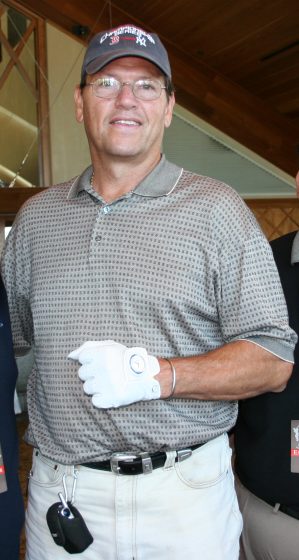
(Notice the cap, paying tribute to the Yanks-Sox rivalry.)

Carlton Fisk, a Red Sox icon... a Yankee? Supposedly, it almost happened.

After the 1985 season, the Chicago White Sox didn’t want to sign him to a new contract, and Don Baylor wasn’t happy with the reduced at-bats he was getting as a Yankee. So a trade was discussed, but since Fisk’s contract had run out, and the MLB owners were then in the early stages of the “collusion” for which they would later be massively penalized, the Yankees wouldn’t simply sign Fisk. The ChiSox would have to sign Fisk first, then trade him to the Yankees for Baylor.

But owners Jerry Reinsdorf and Eddie Einhorn (a.k.a. the Reinhorn Twins) couldn’t come to an agreement with Fisk, and the trade fell apart before, ultimately, Fisk was re-signed.

Don’t believe me? Here’s a link: http://en.wikipedia.org/wiki/Carlton_Fisk#Almost_a_Yankee

True, it’s hard to imagine the former heart and soul of the Boston Red Sox, a man who had home-plate collisions-turned-brawls with Thurman Munson in 1973 and Lou Piniella in 1976, a man whose rivalry with fellow catcher Munson turned nasty at other times, in Pinstripes. (Since Butch Wynegar already had the Number 27 Fisk wore in Boston, Fisk probably would’ve kept the Number 72 he wore in Chicago.)

But we’ve seen Red Sox legends Wade Boggs and Roger Clemens as Yankees. We’ve seen Met icons Darryl Strawberry, Dwight Gooden, David Cone and, if you can call him a “Met icon,” Joe Torre as Yankees. We’ve seen famed Yankee Killers Clemens, Rickey Henderson, Jose Canseco, Jimmy Key and Randy Johnson as Yankees. So is it really that odd to think that Fisk might have been a Yankee?

What would have happened?

*

First, let’s address the team for whom he really did play, the White Sox. They came close to an AL West title in 1990, won it in 1993, moved to the AL Central and were on track to win it when the Strike of ’94 hit... but ’93 was Fisk’s last season, and he’d already been replaced by Ron Karkovice.

So unless Fisk’s absence is so debilitating to the team, and Baylor’s presence not enough of a lift, as to prevent the approval of the funding for the new Comiskey Park (what is now U.S. Cellular Field) in the Illinois legislature in 1988, which would have sent the Pale Hose to Tampa Bay, chances are nothing changes for the that team.

Would having Fisk have benefited the Yankees? His 1986 to 1991 seasons were okay, but not great. Then he tailed off, just in time for the Yankees to get good again. But he was still better at the plate than Wynegar in ’86, the triad of Rick Cerone-Joel Skinner-Mark Salas in ’87, and the platoon of Salas and Don Slaught in ’88. In those seasons, the Yankees missed winning the AL East by 5½, 9 and 3½ games.

Would Fisk’s hitting and handling of pitchers have made a difference? In ’86, probably not. In ’87, definitely not; it's not often that one player, especially one 40 years old, can make a 9-game difference over the average player.

In ’88, possibly: A 6-game losing streak from August 25 to 30, right in the middle of a roadtrip that began with a makeup game in Milwaukee (a frequent trouble spot for the Yanks when the Brewers were still in the AL), followed by that seemingly-inevitable annual Coast-trip killer of Anaheim, Seattle and Oakland, hurt the Yanks very badly. They lost the Milwaukee game. They got swept by the Angels, losing 7-6 (in 12 innings), 12-0 and 13-2, as bad a series as they’ve ever had since I’ve been old enough to pay attention. They salvaged the finale against the Mariners and only won the first against the A’s. Then they dropped 2 of 3 at home to Cleveland (I was at the Tuesday night game, an awful 1-0 loss with Greg Swindell outdueling Al Leiter), before sweeping a 4-game set with Detroit (I was at the Saturday afternoon game). But dropping the last 3 of a 4-game set at Fenway in mid-September dashed their hopes, and dropping the last 3 of the season in Detroit ended them. Could Fisk have done enough in that stretch, 17-20, to make it 22-15 (thus avoiding a 10th Anniversary Playoff with the Red Sox) to win the AL East? Maybe.

Actually, what really killed the Yankees in 1988 was an injury to John Candelaria, a Brooklyn native who’d starred for Pittsburgh and had pitched for the Mets the year before. He was 13-7 with a 3.38 ERA, but pitched an inning and a third on August 24 and was out for the year. Maybe Fisk would have seen something in the Candy Man before that, and he could’ve been taken out before it got worse, and been available, so the Yankees wouldn’t have had to use relievers like Lee Guetterman and Pat Clements as starters.

Candelaria gets forgotten today, but in his career he was 177-122, with a 114 ERA+ and a 1.184 WHIP. He was really good, and still a solid pitcher at age 36. He was 34 in 1988, and from August 24 onward the Yankees had several games where Guetterman, Clements, Charlie Hudson, Scott Nielsen, Dale Mohorcic and Steve Shields were the losing pitchers.

So in TTL-1988 we have the first-ever season in which both the Yankees and the Mets make the postseason, which didn’t happen in RL until 1999. The Yanks beat out the Red Sox for the Division, and face the Oakland Athletics in the ALCS (remember, no Division Series in those days).

In RL, the A’s won 104 games and swept the Sox, then got embarrassed by the Dodgers in one of the biggest World Series upsets.

If we use the Yankees’ actual rotation of that season, and how it worked out in their final few starts, here’s how the TTL-1988 ALCS would have stacked up, presuming the Candy Man comes back:

Game 1, Wednesday, October 5, at the original Yankee Stadium: Richard Dotson vs. Dave Stewart. Stewart was known as “Smoke,” for good reason. He allowed just 6 hits at Fenway. But with the Yankees’ lefty bats, it then becomes a question of whether Dotson could hold off the Oakland Bash Brothers. Probably not. In RL, A’s 2, Red Sox 1. I’m not sure what the TTL-score would have been, but the A’s still win, and lead 1-0.

Game 2, Thursday, October 6, at Yankee Stadium. Rick Rhoden vs. Storm Davis. Davis was a good pitcher, but Rhoden was a find for the Yanks that season. The A’s needed 3 runs in the 7th off Roger Clemens and 1 in the 9th off Lee Smith to win it. Maybe Dave Righetti slams the door. Yankees 3, A’s 1. Series tied 1-1.

Game 3, Saturday, October 8, at the Oakland-Alameda County Coliseum: Tommy John vs. Bob Welch. The Yankees don’t have Reggie Jackson to hit against Welch anymore, but then, neither do the A’s have Reggie to hit against Fritz Peterson. In RL, the A’s clobbered 1983 Oriole hero Mike Boddicker. But they’re not going to like batting against TJ’s sinkers. Yankees 6, A’s 2. Yanks lead series, 2-1.

Game 4, Sunday, October 9, at the Coliseum: John Candelaria vs. Stewart. No way Stew has 2 bad outings in a row. Not at that stage of his career. He held the Sox to 4 runs in RL, riding a Canseco dinger to a 4-1 A’s win. Let’s keep it that way, to keep it simple: A’s 4, Yanks 1. Series tied 2-2. Remember, in RL, this was the end of the series. (It was Game 4 in 1990 when Clemens went nuts and the A’s swept the BoSox, not 1988.)

Game 5, Monday, October 10, at the Coliseum: Dotson vs. Davis. Dotson bounces back, Davis doesn’t. Yankees 6, A’s 4. Yanks lead series, 3-2.

Game 6, Wednesday, October 12, at Yankee Stadium: Rhoden vs. Welch. Ten years earlier, they (and also Tommy John) were Dodger teammates, going against the Yankees (including current manager Lou Piniella) in the World Series. If this were 1990, by which point Rhoden was washed up and Welch was winning 27 games, I’d give it to Welch. Not this time: Mike Pagliarulo homers off him in the 8th, and the Yankees win, 4-2, and win their 34th Pennant.

There is no Subway Series, as the Mets have capitulated to the L.A. O’Malleys. The National League half (pardon me while I laugh) of New York had their best chance yet to gain revenge on the family that stole the Dodgers from Brooklyn, and they failed.

*

The TTL-1988 World Series: It’s Yanks vs. Bums, for the 12th time – the 5th since the Bums caught the last train for the Coast.

Game 1, Saturday, October 15, at Dodger Stadium: John vs. Tim Belcher. In RL, TJ appeared in 3 World Series, all Yanks vs. Dodgers, and lost them all (1977 and ’78 with the Bums, ’81 with the Yanks). Time for redemption. In RL, the Bums scored 2 in the 1st off Stewart, but the A’s came back with 4 in the 2nd to knock Belcher out of the box. In 1995, Belcher would be a Seattle Mariner, and give up Jim Leyritz’s 15th inning homer in the rain – for all the good THAT did the Yanks in the end. You know how this game ended in RL: Kirk Gibson vs. Dennis Eckersley. And the Eck was a much better reliever than Rags. Well, guess what: Righetti was a lefty. You think Dodger manager Tommy Lasorda is gonna send Gibson up against a hard-throwing lefty? Maybe, he was dumb enough to led Tom Niedenfuer pitch to Jack Clark in the ’85 NLCS, and a Pennant-winning homer was the result. (And Clark was the Yanks’ main DH in ’88.) Righetti strikes out Gibson. Yanks 4, Bums 3. Yanks lead 1-0.

Game 2, Sunday, October 16, at Dodger Stadium: Candelaria vs. Orel Hershiser. Scratch this one: Hershiser pitched a 3-hit shutout against the East Bay Bash Brothers, and there's no reason why he can’t do it against the Bronx Bombers. Same score as in RL: Dodgers 6, Yanks 0. Series tied 1-1. But to get out of Chavez Ravine with a tie is pretty good, especially since the RL-A’s couldn’t.

Game 3, Tuesday, October 18, at Yankee Stadium: Dotson vs. John Tudor. The 11th anniversary of Reggie Jackson’s 3 homers, and don’t think that TTL-George Steinbrenner doesn’t want to invite Mr. October back to throw out the ceremonial first ball. In RL, this was a tight pitchers’ duel between Welch and Tudor, who was one of the heroes of the St. Louis Cardinals’ 3 Pennants in the Eighties. Now in Dodger Blue, he’s facing Yankee Pinstripes instead of Oakland Green. Mark McGwire won this with a walkoff homer, making it the only RL-World Series with 2 walkoff homers. (Not to mention Eck coined the phrase “walkoff homer” after giving up Gibson's.) Maybe Fisk is the hero this time. Or Don Mattingly. Or... naw, Tommy Lasagne wouldn’t bring Niedenfuer in to face Clark again, would he? Would he? Nope, Niedenfuer had been traded to Baltimore. So he brings in the man who gave up the not-so-Big Mac’s homer, ex-Yankee Jay Howell. Doesn’t matter: Clark hits it into Monument Park. Yanks 2, Bums 1. Yanks lead Series by same margin.

Game 4, Wednesday, October 19, at Yankee Stadium: Rhoden vs. Belcher. Belcher was better this time, and maybe the Dodgers tie it up. Dodgers 4, Yanks 3 (the RL score), and the Series is tied, 2-2.

Game 5, Thursday, October 20, at Yankee Stadium: John vs. Hershiser. Two of the smartest pitchers who ever lived. In RL, on 3 days’ rest, Hershiser was very strong, going the distance and allowing just 2 runs on 4 hits and 4 walks. The Dodgers scored 2 in the 1st and 2 in the 4th off Storm Davis; even at age 45, TJ could do better than that through 4. Still, I don’t see the Yankees winning this one. Dodgers 3, Yanks 2. Dodgers lead Series by same margin.

Game 6, Saturday, October 22, at Dodger Stadium: Candelaria vs. Tudor. The Candy Man hasn’t made much of a difference yet, but he does have 4 days’ rest while Tudor has just 3. And, if you’ll remember, Tudor spit the bit for the Cards in the previous year’s Game 7. I see a Mattingly homer. I see a Clark homer. I see a Pags homer. I even see Dave Winfield shaking off George’s “Mr. May” tag and homering. Yanks 9, Bums 5. We’re going to a Game 7!

Game 7, Sunday, October 23, at Dodger Stadium. Does Fat Tommy bring Orel back on 2 days’ rest? It worked for Bob Gibson in ’64, Sandy Koufax in ’65 and both Denny McLain and Mickey Lolich in ‘68, but not Jim Lonborg in ’67. Well, it is Game 7, which means Johnny Wholestaff needs to be ready. That means Hershiser doesn’t start, but he may come out of the bullpen. After all, he’ll have 4 months of rest before pitchers and catchers report. So it’s Tim Belcher for L.A. For New York? Richard Dotson on 4 days’ rest, or Rick Rhoden on 2? Sweet Lou gambles and goes with Rhoden, who attempts to become the 2nd Yankee World Series hero, after Mickey Mantle, to have survived osteomyelitis as a child.

Belcher leaves a fat pitch in Winfield’s wheelhouse, and Big Dave sends it into the San Gabriel Mountains. Mattingly scores ahead of him. It’s 2-0 Yanks before the Dodgers even get to bat. The Yanks squeeze single runs across in the 3rd and 4th, and Tommy has seen enough: Out goes Belch... er, in comes Hershiser. Hershiser cruises through the 8th.

Rhoden starts fine, but wobbles in the 5th, allowing a run. Piniella takes him out and brings in Dotson, who gets out of the jam and is fine until the 8th. It’s 4-1 Yankees, but the Dodgers load the bases with just 1 out. The pitcher’s spot comes up, and Hershiser is a career .201 hitter. Lasorda needs a pinch-hitter. Back goes Hershiser, up comes Pedro Guerrero, a righthanded hitter. Out comes Dotson, in comes...

Candelaria? Lou guesses that Tommy really wanted to send Kirk Gibson up, and doesn’t want to pitch Righetti for more than 1 full inning, so he sends in the Candy Man to make Gibson a lefty against a lefty. Seeing this, Lasorda leaves Guerrero in, and while he drives it to deep center field, it’s not enough: Claudell Washington catches it, sends it home, and only 1 run scores. Candelaria gets Steve Sax to pop up, and the threat is over.

Righetti gets the last 3 outs, and the Yankees win, 4-2, and take their 23rd World Championship.

In 2007, ESPN Classic airs "The Top 5 Reasons You Can't Blame Tommy Lasorda for Pinch-Hitting For Orel Hershiser in the 1988 World Series."

Reason Number 5: Orel Hershiser. He'd only had 2 days' rest. Who knows if he would have had anything left to get 3 outs in the 9th inning? And he wasn't a good-hitting pitcher like Rick Rhoden or Bob Welch, or even...

Reason Number 4: Fernando Valenzuela. He was injured. If El Toro had been able to pitch in the postseason (which didn't matter in RL, as it turned out), Lasorda would not have had to give any postseason starts to...

Reason Number 3: Tim Belcher. If he had started Game 7 well, Hershiser wouldn't have been in the game in the first place.

Reason Number 2: Pedro Guerrero. He was a good hitter, and he did get one run home. Not to mention that Kirk Gibson we was injured, and a lefty besides, who would have batted against a lefty, either Candelaria or Righetti. Sending him up to pinch-hit would've been a bad idea. So Guerrero was the Dodgers' best option.

Reason Number 1: The Yankees were better.

*

For Dave Winfield, Tommy John, Rickey Henderson, Don Mattingly and, yes, Carlton Fisk, it is their first ring.

It is not, however, the start of a new dynasty. Injuries to Winfield, Mattingly and Clark lead to TTL-1989 being just like RL-1989, and the Yanks go downhill fast. The history we know reasserts itself. By 1993, the next Yankee dynasty is underway, but, of the ’88 Yanks, the only one who will make it even to the end of ’93 is Mattingly. And he won’t make it to ’96, just like in RL.

But if Carlton Fisk had become a Yankee, as weird as it would have seemed, it might just have meant a big, big difference.

Especially for the Mets, and their fans, as their momentum from ’86 dies after only 2 years, and the Yankees and their Fans reclaim New York 8 years sooner. Tough luck for the Flushing Heathen. Poor babies.

Wednesday, March 21, 2012

What If the Dodgers Had Won the 1951 Pennant?


Bobby Thomson, God rest his soul, couldn't hit anything but a fastball. Ralph Branca, good guy and a good pitcher in some situations, didn't have good command of anything but a fastball. Carl Erskine could have been brought in, and he had a really good curveball that became a great one...

Erskine gets Thomson to ground into a double play. The Dodgers win the Pennant.

Having won the 1951 National League Pennant, would the Brooklyn Dodgers have beaten the New York Yankees in the World Series?

It's certainly possible: The New York Giants, who beat the Dodgers in RL, took 2 of the first 3 against the Yankees. But the Yanks took the next 3 straight to win it in 6.

A look at the Dodgers' starting pitching, though, reveals a big problem:

* The World Series started on October 4, the day after the Playoff. It had been scheduled to start on October 2, 2 days after the regular season ended.

* There were no travel days when it was a Subway Series. If it went the full 7, it all happened within 7 days, barring a rainout.

* Don Newcombe pitched 272 innings in 1951, including 8 1/3 in Game 3 of the Playoff. He could not have started again until Game 4 of the Series -- Game 3 if Dodger manager Charlie Dressen were willing to risk him on 2 days' rest, like Phillies' manager Eddie Sawyer did with Robin Roberts the year before (and it almost worked).

* Clem Labine went the distance in Game 2 of the Playoff. Given 3 days' rest, he would not have been available until Game 2 of the Series.

* Ralph Branca went 8 in Game 1 of the Playoff, so while pitching to 1 batter (and warming up before that) in Game 3 wouldn't have hurt him, he wouldn't have been available until Game 2 of the Series, either.

* The last scheduled day of the regular season, September 30, the Dodgers went 14 innings in beating the Phillies and forcing the Playoff series with the Giants. Elwin "Preacher" Roe started, making him available for TTL-WS Game 1, but got rocked (a rare bad outing in a 22-3 season for him). Branca pitched an inning & a third, not much additional wear there. Clyde King and then and Labine followed with an inning each, Erskine 2, Newcombe 5 2/3 (meaning he went into the 9th on 2 days' rest to pitch the Pennant clincher), and Bud Podbelian went the rest of the way for the win, and also pitched the 9th in Game 1 of the Playoff.

* Joe Black, who did yeoman work for the Dodgers in 1952 and '53 while Newcombe served in the Korean War, was still in the minors, and not available for the '51 Series.

*

So, based on that, here's what the starting pitching matchups for the TTL-1951 World Series would likely have been:

Game 1: Roe vs. Allie Reynolds. In RL, the Giants started Dave Koslo, and beat the Yankees 5-1.

Game 2: Labine vs. Eddie Lopat. In RL, the Giants started Larry Jansen, who came in to relieve Sal Maglie in the Pennant clincher 2 days earlier, and he pitched well, but the Yankees won 3-1. This is the game where Giant rookie Willie Mays hit a ball to right center where Yankee veteran Joe DiMaggio waved off rookie Mickey Mantle, Mickey stopped short so as not to crash into Joe, stepped in a drain that had been left open, and tore up his right knee, leaving him out for the Series and damaging his career in ways that can be examined at another time.

Game 3: Newcombe vs. Vic Raschi. In RL, the Giants started Jim Hearn, and beat the Yankees 6-2.

Game 4: Branca vs. Reynolds. In RL, the Giants started Sal Maglie, and the Yanks won 6-2 thanks to a Gil McDougald grand slam.

Game 5: Roe vs. Lopat. In RL, the Giants started Jansen, but the Yanks smacked him around, scoring 5 in the 3rd and plugging away to a 13-1 win.

Game 6: Labine vs. Raschi. In RL, the Giants started Koslo, but the Yanks won 4-3 to take the Series. This was DiMaggio's last game. His last at-bat came in the 8th, and he doubled to left-center off Jansen.

Game 7: Newcombe vs. Reynolds. In RL, of course, this game was never played.

So let's speculate on what would have happened if it had been Dem Bums, rather than Da Jints, against the Bronx Bombers:

Game 1, October 4 at the original Yankee Stadium: If Koslo could shut down the Yankees, certainly Roe, with his sinker (cough-spitball-cough) could have. Different opponent, same result, same score: Dodgers 5, Yankees 1. Dodgers lead, 1 game to 0.

Game 2, October 5 at Yankee Stadium: The junkballing Lopat never seemed to get tired, while Labine, even on 3 days' rest, may not have been at his best, even though he usually pitched very well against the Yanks. (This included in the 1960 World Series for Pittsburgh.) Perhaps if Duke Snider, a lefty pull hitter, were batting instead of Mays, the ball that DiMaggio took from Mantle goes right to Mantle, and he doesn't hurt his knee, but let's not consider the long-term implications yet. Lopat outduels Labine. Yankees 3, Dodgers 1. Series tied, 1-1.

Game 3, October 6 at Ebbets Field: Newcombe would not have been as rested as RL-Game 3 starter Hearn. Instead of a 6-2 NL win, the AL Champions get to Newk and the Dodger pen. Yankees 7, Dodgers 6. Yankees lead, 2 games to 1, and already we have a substantially different World Series in TTL.

Game 4, October 8 at Ebbets Field: The Dodgers get what they need so badly, a day's delay due to rain. No question about it, if Sal the Barber, with his devastating curveball (and he was never better than in 1951), could give up a grand slam to McDougald (a good contact hitter but not a lot of power), then surely Branca would have. Or would he? We're not in the Polo Grounds now. But, knowing that Branca is a fastball pitcher, McDougald may have tried to pull the ball, instead of not trying to against Maglie's hook. Figure a double instead of a homer. Yankees 4, Dodgers 2. Yankees lead 3 games to 1.

Game 5, October 9 at Ebbets Field: As breaking-stuff experts, neither Roe nor Lopat benefits much from the extra day of rest. But facing a rested Roe instead of a tired Jansen may mean the Yankees don't score 5 runs in the 3rd. Maybe the Dodgers win this one. Dodgers 5, Yankees 4. Yankees lead 3 games to 2. So now we're back to where we were in RL.

Game 6, October 10 at Yankee Stadium: Labine is now fully-rested, and maybe that makes the difference, since the fireballing Raschi will have had just 3 days' worth. Dodgers 3, Yankees 1. Series tied, 3-3, and the Game 7 that didn't happen in RL happens in TTL.

Game 7, October 11 at Yankee Stadium: Think the Yankees can't lose a Game 7 at home? They already had, in 1926 (St. Louis Cardinals). And they would again in 1955 (Dodgers) and 1957 (Milwaukee Braves). So we have Big Newk on 4 days' rest, and the Superchief on 3.

This is where, as it did in RL-1952 Game 7, the Yankee bullpen has a chance to make the difference, as Newk, closing in on 300 innings pitched for the year, is shaky, and Dressen can't bring in a reliever as good as Bob Kuzava, who pitches the 9th in relief of Reynolds. Yankees 7, Dodgers 4. Yankees win Series, 4 games to 3.

*

So what's the verdict? Was it really worth it for the Dodgers to win what was, in RL, the Bobby Thomson Pennant? They don't win the Series anyway, although they have their chances. Would it really have made the difference?

Maybe, if Walter O'Malley had started immediately to work with City officials to get a new ballpark to replace Ebbets Field, with its 31,497 seats and 750 parking spaces. Maybe the Dodgers don't move to Los Angeles. Maybe this leads to the Giants getting out of the Polo Grounds and into the stadium that Robert Moses wanted to build in Flushing Meadow, the one that became known in RL as Shea Stadium.

But let's get real: In RL, the Dodgers moved 1 year after winning a Pennant, and 2 years after winning a World Series. If that success didn't stop O'Malley from moving the team, surely an additional Pennant (or even title) wouldn't have swayed him.

What would have happened if the Dodgers and Giants had stayed in New York? That's an entry for another time. As are what might have happened had one stayed and not the other.

*

If the Dodgers had won the 1951 Pennant, I suppose the biggest difference is that the New York Giants get more forgotten in the wake of the celebrations of Casey Stengel's Yankees and the Dodger Boys of Summer. After all, the Giants didn't win title after title, and there was no great book written about them as they moved into middle age by an equivalent to Roger Kahn.

Bobby Thomson died in 2010. Without that home run, he'd be on the level of other '51 Giants, like Whitey Lockman and Don Mueller and Wes Westrum. Except they were still with the Giants when they won the '54 Series -- Thomson wasn't.

And, of course, Ralph Branca never gives up that home run, and is probably remembered as follows: "What happened to him? He won 21 games at age 21, and then... and then... Huh? How come he couldn't keep it going? I don't get it."

This makes it sound like Thomson did Branca a favor. Which, I assure you, is not what happened.

Someday, I'll do a post about what would have happened if, in the '54 Series, Willie Mays hadn't made The Catch. You may be surprised: He is actually the person who ends up the least affected by that, although it'll mean that the Giants' 2010 World Series win isn't their first since 1954, it's their first since 1933! 56 years is bad enough, but 77 years?

Tuesday, March 20, 2012

What If Dwight Gooden Had Stayed Clean?


NOTE: The following was written in March 2010, after Gooden had been pulled over for drunk driving. The story presumes that he never fell victim to substance abuse, which we first found out about on April 1, 1987 -- April Fool's Day, nearly 25 years ago.

Remember back in 1984, when Dwight Gooden was just 19 years old, went 17-9, and set a rookie record with 276 strikeouts? Met fans were already saying he was the greatest pitcher ever.

It was like Knick fans would get a year later after they got the top pick in the NBA Draft (wonder how that happened) and used it on Patrick Ewing: It wasn't if he would lead them to championships, it was how many.

The Mets finished 2nd that year, but the next year, 1985, they looked ready to make a serious challenge at the World Series. With Gooden, Darryl Strawberry and Keith Hernandez already in place, they added Gary Carter. They came close, chasing the St. Louis Cardinals for the National League Eastern Division Title to the last weekend before falling short. Gooden had one of the best seasons any pitcher has ever had: 24-4, ERA of 1.53, 268 Ks, and a WHIP of 0.965. (Walks and Hits, divided by Innings Pitched. Anything under 1.3 is good. Under 1.2 is excellent. Under 1.0 is ungodly.)

Dwight Gooden, "Doctor K" (eventually just "Doc"), won the Cy Young Award the year after being Rookie of the Year. He had won 41 games before he was old enough to legally drink. His future, and the Mets' seemed limitless.

In 1986, it all came together. True, he went "only" 17-6, and he failed to win either of his World Series starts (but then, he was opposed in both by Roger Clemens, who was every bit as dominating in '86 as Gooden was in '85), but the Mets did win the Series, after winning 108 games in the regular season.

What a rotation: Dwight Gooden, Ron Darling, Sid Fernandez, Bob Ojeda. A bullpen with Jesse Orosco, Roger McDowell and Randy Myers. An outfield of Kevin Mitchell, the platoon of Mookie Wilson and Lenny Dykstra, and Darryl Strawberry. An infield of Keith Hernandez, Wally Backman, Rafael Santana and Howard Johnson -- and Backman and Johnson could be platooned with Tim Teufel and Ray Knight, respectively, with occasionally "Amazin'" results.

At the City Hall celebration after the ticker-tape parade -- a bigger one than the Yankees had ever received to that point, but, then again, then-Mayor Ed Koch was a Met fan (no wonder he went bald: He probably pulled out most of his hair!) -- Mookie told the crowd, "1986: The Year of the Mets! 1987: The Year of the Mets! 1988: The Year of the Mets!"

Big roar. No one doubted him. Yankee Fans feared it would be true, but even we found it hard to doubt that it could happen.

*

But that was when things began to go wrong for the Mets. They traded Mitchell for Kevin McReynolds, who just didn't produce the way Mitchell did the next few years. They released Knight, which became a problem when HoJo kept getting hurt. Hernandez hurt his back and got old in a hurry. They traded Dykstra for Juan Samuel, a great trade for the Phillies but yet another in a long list of bonehead moves for the Mets. Hot prospects Dave Magadan and Gregg Jeffries didn't quite work out.

Through it all, Gooden kept on pitching. In 1987, he went 20-9, as the Mets again finished 2nd to the Cardinals, by just 1 game. In 1988, he had another great year, going 18-9, and starting the All-Star Game, as he had in '84. But a little foreshadowing came when he gave up a home run to the weakest hitter in the American League's starting lineup: Terry Steinbach, the catcher for the Oakland Athletics.

The Mets again won the NL East. Gooden shut down the Los Angeles Dodgers in Game 3 of the National League Championship Series, and the Mets won that series in 5. This enabled Gooden to start Game 1 of the World Series, but, again, he was victimized by an A's homer, as manager Davey Johnson left him in to pitch a complete game, and in the top of the 9th, Mark McGwire crushed one over the picnic area in Shea Stadium's left-center field, turning a 4-3 Met lead into a 5-4 A's win. The Mets never recovered, and the A's won in 5 games, with Gooden also losing the clincher.

Gooden sustained his first major league injury in 1989, but bounced back to put together a 12-5 season. The Mets again finished 2nd, to the Chicago Cubs as they had in '84, Gooden's first season. In 1990, he was 19-7, but the Mets again finished 2nd, this time to the Pittsburgh Pirates.

Another injury in 1991 left Gooden only 13-7, but by now the Mets had collapsed. In 1992, they were so bad that Bob Klapisch, the Mets' beat writer for the New York Daily News, published a book about them, titled The Worst Team Money Could Buy. Gooden fell to 10-13 in '92 and 12-15 in '93 as the Mets lost 103 games. For a while, in '93, they were ahead of their 1962 team's 20th Century record pace of 120 losses, and they were a bunch of juvenile delinquents as well, tossing firecrackers that ended up hurting children, spraying reporters with bleach, threatening reporters with physical harm. (Including Bobby Bonilla to Klapisch: “Make yo’ move, ‘cause I’ll hurt you!”) In all this, Gooden, now 28, was a beacon of maturity.

But improvement was not on the horizon for a man who seemed, with injuries and a poor supporting cast, to have fallen off the Baseball Hall of Fame's radar. In 1994, with a players' strike shortening the season, and a rotator cuff shortening his own, Gooden finished just 3-5. He bounced back in 1995, going 7-3 in limited action, but the atmosphere in Flushing Meadow was so bad that he wanted out. He entered the free agent market.

*

That's when Yankee owner George Steinbrenner pounced. In one of the great coups in baseball history, he took the biggest star the Mets had produced since Tom Seaver, and brought him to The Bronx.

On May 14, 1996, Dwight Gooden did something neither he, nor any other human being, had done, or still has done, in a Met uniform: He pitched a no-hitter. He blanked the Seattle Mariners as the Yankees won, 4-0. Rejuvenated, he went 13-8, and won Game 4 of the World Series, as the Yankees beat the Atlanta Braves in 6 games. (Note: Gooden doing the job that Kenny Rogers failed to do erased that 6-0 to 8-6 comeback, which means that Jim Leyritz is mainly known for his rain-strewn walkoff homer in Game 2 of the 1995 ALDS.)

Gooden again pitched well for the Yankees in 1997, going 16-9, helping them beat out the Baltimore Orioles for the AL East title, the Cleveland Indians in the ALDS, the Orioles again in the ALCS, and the upstart Florida Marlins in the World Series.

None of those teams have made the World Series since; in fact, only the Indians have even reached the postseason since, and South Florida doesn't even have a team anymore, after the Marlins were broken up, attendance sank like a stone, and the team was moved to Washington, D.C. Rumors abound that the Montreal Expos, if they can't get a deal for a new ballpark to open by the 2014 season, may move to Miami, but they'd still be stuck in whatever the Miami Dolphins' stadium is being called these days.

Gooden hadn't had a 200-strikeout season since 1990, and only that one since 1986, but it didn't matter, as, like his former Met, now Yankee, teammate David Cone, he became a smarter pitcher with age -- or, if you prefer, a pitcher rather than a thrower. The 1998 Yankees were the greatest team of all time, with a rotation of Cone, Gooden, Andy Pettitte, David Wells, and Orlando "El Duque" Hernandez, making the '86 Mets look like pikers. Their 117 wins were the most in baseball history, including Gooden's 12-9 record. They swept the Texas Rangers in the ALDS, took the Indians in 5 in the ALCS, and swept the San Diego Padres for their 3rd straight World Series. The Yankees had an unbelievable 11-1 postseason, the greatest performance in baseball's postseason since the '76 Reds went 7-0 (facing a maximum of 12, as opposed to 19).

Gooden finally seemed to slow down in 1999, at age 34, going 12-9 but with an ERA of 4.70. He did not appear in the Yankees' 2nd straight 11-1 postseason. An 11-10 season in 2000 showed him the writing on the wall, though it also showed him a 5th straight World Series ring -- something only the 1949-53 Yankees had previously done. He had surgery on his shoulder, allowing him to come back in time for the 2001 stretch drive, going 4-1 in limited action. He managed to shut down the Arizona Diamondbacks in emergency relief of Andy Pettitte in Game 6 of the World Series, and the Yankees claimed their record 6th straight World Championship, their 28th World Series overall.

It was too much for his shoulder, and Gooden sat out the entire 2002 season, in which the Yankees lost to the Anaheim Angels in the ALDS. But he was back in 2003, squeezing out one more solid season, going 15-12, with his first 200-K season in 13 years. His heroic bullpen work saved the Yankees in Game 7 of the ALCS against the Boston Red Sox, leading to Aaron Boone's epic home run to win the Pennant. Doc again pitched in relief to shut down the Chicago Cubs, in their first World Series in 58 years, to win Game 4, allowing the Yankees to beat the Cubs in Game 6 for Title 29. (Note: With the Marlins in disarray, and in Washington, the Cubs don't collapse in the NLCS. They do get the Pennant, if not the whole thing.)

*

But the end was near. The pain was too great for much of the 2004 season, and Doc announced it would be his last. He would, after all, be turning 40 shortly after it ended. But he did manage to make his last regular-season strikeout the 3,000th of his career. The Doctor still had one last procedure to perform.

With the Red Sox (cough-steroids-cough) having completed baseball's first-ever 3-games-to-0 postseason comeback, manager Joe Torre had a tough choice to make in Game 7. Pettitte had been allowed to leave for Houston. So had Roger Clemens. Mike Mussina wasn't ready. Neither was Jon Lieber. Wells had left. Kevin Brown hadn't been effective. Neither had Javier Vazquez. Neither had Esteban Loaiza. El Duque was hurting. So was Doc.

Doc sucked it up and said, "Skip, gimme that ball."

Joe gave Doc the ball. He sent the Sox down in order in the 1st. In the 3rd, David Ortiz led off. The biggest Yankee-killer of his generation had pummeled them the last 2 seasons, but Gooden stuck a fastball -- "The last good one I ever threw," he would tell the press -- right in Big Papi's fat ribs. Ortiz pointed at the mound, and Gooden, in his best imitation of an English hooligan's "Come on then" style, threw out his arms and accepted the challenge. Both benches cleared, and Ortiz flattened Gooden. Not by punching him, but by falling on him. That would flatten anyone. The umpires threw both men out of the game, thus requiring a new pitcher for the Yankees, but also taking the Sox' biggest threat out.

Vazquez came in, settled things down, and held the Sox off until the 7th. Then the Sox made the mistake of bringing Pedro Martinez in to pitch, and he found out "Who's your Daddy!" The Yankees tallied twice off him to take a 3-0 lead. Mariano Rivera pitched the last 2 innings to give the Yankees their 41st Pennant.

The Curse of the Bambino lived, and still lives. Ortiz, Manny Ramirez, Jason Varitek, Trot Nixon, Mark Bellhorn and Bill Mueller were soon outed as steroid users. Sox management allowed Pedro to leave Boston via free agency, just as they did to Clemens after 1996.

The Red Sox have not won a World Series for 94 years. This past offseason, team owner John Henry, fed up with it all, sold the team to a Russian oil billionaire, who has promised to build a new ballpark on landfill in Boston's North End. "Of course," Yankee Fans are saying. "Landfill for a garbage team." Sure, build a ballpark on landfill. After all, it worked so well for Cleveland Municipal Stadium, right?

Gooden pitched just one inning in the World Series against the Cardinals, but he said it was sweet revenge for 1985 and '87 with the Mets. The Yankees had their 30th World Championship, and Dwight Gooden walked away from baseball with a 9th World Series ring. Only Yogi Berra then had more (though Rivera, Derek Jeter and Jorge Posada have now matched Yogi).

Dwight Gooden retired with a career record of 256-149, for a superb winning percentage of .632, and just barely entered the 3,000 Strikeout Club – all this despite several injuries that got in his way.

After Gooden's retirement, the Yankees hit a little dry spell, as the World Series was won by the Chicago White Sox in 2005, the Cardinals in 2006, the Colorado Rockies in 2007, and the Philadelphia Phillies in 2008, before the Yankees dethroned the Phils in 2009, and the San Francisco Giants won in 2010 and the Cards again in 2011.

Gooden was caught speeding in March 2010, on his way to a banquet honoring his recent election to the Baseball Hall of Fame.

Some say he was the greatest New York pitcher ever. Well, probably not. Not even if you include what he did for the Mets.

Still, Dwight Eugene Gooden is a Yankee hero, and a baseball hero. With his injuries, it could have been a lot worse.

In fact, it could have been even worse than that. Look at his former Met and Yankee teammate Darryl Strawberry. Can you imagine if Gooden had wasted his life on cocaine and alcohol? It could have been not just a shame, but a tragedy.

What If Andy Pettitte Had Never Left the Yankees?


With the "third coming" of Andy Pettitte, I bring back this piece, inspired by Lisa Swan of Subway Squawkers (see link to the right).

December 15, 2003 (point of divergence): As he previously had to talk George Steinbrenner and Brian Cashman out of trading him in 1999, so again does Yankee manager Joe Torre succeed in getting them to sign Andy Pettitte to a new contract.

October 20, 2004: Sorry, Yankee Fans, but Andy is no help in the meltdown against the Red Sox. In RL, he got hurt and didn't pitch after August 12. The Astros made the Playoffs anyway, but lost to the Cardinals. Andy doesn't come back any sooner if he stays in New York.

October 7, 2005: If the Yankees keep Pettitte, they don't desperately need another lefty, and they don't get Randy Johnson. So Pettitte starts Game 3 of the ALDS against the Angels. Instead of the Big Unit allowing 5 runs in the first 3 innings, resulting in an 11-7 Angel win, Pettitte allows 4 runs over 6, and the bullpen holds on for a 7-6 Yankee win. The Yankees take the series the next day.

October 16, 2005: Bad news: In RL, Andy started in the World Series for the Astros against the White Sox, but the South Siders still swept. I doubt he would have made a difference in a Yanks-ChiSox ALCS. No Pennant here. Besides, the White Sox had won just 1 Pennant in the last 86 years. It wouldn't have been right to deny them.

October 6, 2006: Another bad ALDS Game 3 for Randy Johnson turns into a good performance for Andy Pettitte, but it doesn't matter, as Kenny Rogers -- the Tony Fernandez of pitchers, he's lousy for the Yanks and Mets but great for non-New York teams -- pitches a shutout. The Yanks still lose the ALDS.

And in 2007, Andy has never left, and history resumes as we know.

So keeping Pettitte wouldn't have helped, unless it can be argued that he wouldn't have gotten hurt in New York 2004, the way he actually got hurt in Houston.

Sometimes these What-Ifs work out well. This time, the only real difference is that Randy Johnson never pisses us off in Pinstripes. Only in the uniforms of other teams.

Tuesday, March 13, 2012

What If Mickey Mantle Had Taken Care of Himself?


Note: I wrote this before the publication of Jane Leavy's new bio of Mickey, The Last Boy, which mentions that Mickey had admitted to a few people that he had been molested as a boy, possibly explaining his issues with women and with trusting people. But that has nothing to do with my analysis of his injuries and his drinking.

We look at the "Mount Rushmore" of the Yankees -- Babe Ruth, Lou Gehrig, Joe DiMaggio and Mickey Mantle -- and note that, of those, only Joe D lived to see collect Social Security. Aside from smoking, which led to lung cancer killing him at at 84, he took care of himself. The Babe caroused, drinking and womanzing and just plain carrying on, at a rate that would have exhausted even Mickey. And the Iron Horse, who probably took better care of himself than any of them, ironically was struck down by a malady that, while far better researched today, is still mysterious in that no one knows how it is originally contracted. Of the 4, Gehrig should have lived the longest, but he died the youngest, just short of age 38. The Babe, 53. Mickey, 63.

In terms of his health, Mickey Mantle would almost certainly have lived a lot longer if he had drunk only in moderation. Last October, he would have turned 80. But, at that age, he might've been dead by now anyway. His contemporary Duke Snider has now died, leaving Willie Mays as the only survivor of the 1950s New York center field triumverate.

But if Mickey had eased up on the bottle and the running around, and had his many injuries taken more seriously by Yankee management and thus treated better, rendering him fitter, and fit sooner, what difference would it have made on the field?

*

Statistically speaking, he might've gone from 536 career home runs to 600 or so. Not enough to threaten the Babe's then-record of 714, or to surpass Willie Mays' 660, or to avoid being surpassed by the 755 of Hank Aaron and the 762* of Barry Bonds, but still a lot. He also might have gotten a lot more than 2,415 hits. Would he have made it to 3,000? Maybe, if he could have played until he was 42 like Aaron, Mays and Stan Musial (who all made it to 3,000 -- and Ted Williams, who didn't get that milestone due to 5 years in military service).

But how would Mickey's improved health have impacted the Yankees' team performance? Surprisingly, probably very little.

Mickey arrived at Yankee Stadium in 1951. From that point through 1964, the Yankees won the Pennant every year but two: 1954 and 1959. By a weird twist of fate -- I won't call it a "coincidence" because that's what the incurious believe in -- both teams that did win, the '54 Cleveland Indians and the '59 Chicago White Sox, were managed by Al Lopez, one of the craftiest men in the game's history.

In 1954, the Yankees won 103 games, the most any team managed by Casey Stengel ever won. But the Indians won 111, breaking the American League record set by the Yankees in 1927, and establishing a new record that would stand until the Yankees broke it in 1998. Would a healthy Mickey, as opposed to RL-Mickey, have made an 8-game difference? Hardly, because, that season, he did play a full season: 146 games of the the 154-game schedule that was in place from 1904 to 1960, meaning he missed only 8. In those 146 games, he batted .300 with 27 homers and 102 RBIs. By nearly any player's standards, particularly in the Fifties, a pitchers' era, that's a very good season. So any injuries or illnesses he may have had that year didn't affect him very much in terms of stats.

In 1959, the Yankees finished 3rd, 15 games behind the White Sox. Mickey had, by his standards, a subpar season: .285 with 75 RBIs, but still hit 31 homers. And he played 144 games, a full season even by the 162-game standard that was put in place in 1961 (in 1962 in the National League) and has been in place for all non-strike seasons since. No way to say that Mickey could've made a 15-game difference if he'd gone the full 154 even without aches and pains.

Personally, I think a more interesting story is what if Gehrig hadn't gotten sick. And an even more interesting story is what if Roberto Clemente had landed safely. But those what-ifs are for another time.

*

What about those last 4 seasons? In 1965, age, injury, and a dried-up farm system making it nearly impossible to replace those affected by age and injury, combined to form a perfect storm, and it caught up with the Yankees wholesale. They finished 6th in the 10-team, single-division American League, 25 games behind the Minnesota Twins. Could even a healthy Babe Ruth -- hitting 60 home runs and winning 20 games on the mound when he wasn't playing the outfield -- have made a 25-game difference? Not by a long shot.

In 1966, the Yankees finished 10th (one of only 4 last-place finishes in club history, along with 1908, 1912 and 1990), 26 1/2 behind the Baltimore Orioles. In 1967, the Yankees finished 9th, 20 games behind the Boston Red Sox. (The Sox' first Pennant race in 16 years, and they didn't even have to get past the Yankees to win it.) In 1968, the Yankees had a bit of an improvement, a winning season, 5th place, but still 20 games behind the Detroit Tigers.

There was no way Mickey Mantle, healthy and happy even at ages 33 to 36, could have made a 20-odd-games' difference.

And what if he had been able to play until he was 42? Well, who knows, he might've just plain gotten frustrated by all those non-Pennant years and hung 'em up anyway. But if he had stuck with it? Remember, there would have been a decline eventually. In 1969, in the first year of the 6-team American League Eastern Division, the Yankees finished 5th, 28 1/2 games behind the Orioles. In 1970, they had their best season between 1964 and 1976, winning 93 games and finishing 2nd, but still 15 games behind the O's. In 1971, the Yankees finished 4th, 21 games behind the O's.

In 1972, the Baltimore dynasty came to an end, although they did win the Division in '73 and '74, but lost both times to the Reggie/Catfish Oakland Athletics. In '72, the Yanks were 4th, but only 6 1/2 games behind the Tigers.

Now, here is where things get interesting. With Bobby Murcer and Thurman Munson having come into their own, Mel Stottlemyre still one of the game's top starters, and Sparky Lyle having arrived and become the AL's top reliever, could Mickey have made a difference here? Chances are, even with his improved health, he's not playing center field anymore. After all, he is now 40 years old. Maybe he's playing right field in place of Johnny Callison, the former Phillies star. Maybe he's playing first base in place of Ron Blomberg.

At age 40, in 1971, Mays batted .271, with 18 homers and 61 RBIs, but 112 walks meant that he led the NL with a .425 on-base percentage. His OPS+ that year was 158. At age 40, in 1974, Aaron batted .268, 20 homers, 69 RBIs, OPS+ 128. Both were still legitimate All-Stars. Is it so hard to imagine a 40-year-old Mickey batting .270, with 20 homers and 70 RBIs? Especially with Murcer at his peak batting behind him, meaning you couldn't simply walk Mickey because that would put (at least) one man on with such a great hitter coming up -- especially at the pre-renovation Stadium, 296 feet down the right-field line? And would such a season have made a 7-game difference? I think it could.

The next season, 1973, was the first year of the Designated Hitter. As a 41-year-old DH, not having to play the field, Mickey might have had his last good season. But the RL-Yankees tailed off in August after staying well in the race until then, and finished 4th, 17 games behind the Orioles. Maybe a 41-year-old, but healthy, DHing Mickey could have had them in first place on August 1, and maybe that extra boost of confidence gets the Yankees the Division Title.

And in 1974, when Mickey was 42 -- Mays and Aaron were closing it down by that point but Ted Williams and Stan Musial still had good years, if final ones, at that age -- the RL-Yankees were just 2 games behind the Orioles at the end. Mickey platooning at DH with Ron Blomberg, who did bat .311 in 90 games that year: Could it have made the difference? I'm not saying it would, only that it could. Although it would have been very weird in TTL-1974 seeing Mickey playing home games... in Shea Stadium!

*

All right, that's the regular season. What about the postseason?

In 1951, '52, '53, '56, '58, '61 and '62, the Yankees won the World Series. Only in '61 was Mantle injured. So even then, it didn't matter much.

The Yankees lost the 1955 World Series to the Brooklyn Dodgers, the only Series the Dodgers would win while in Brooklyn, before moving to Los Angeles for the 1958 season, and winning the Series in 1959, '63, '65, '81 and '88. In '55, Mantle was hurt. He did not play in Games 1 and 2 (Irv Noren played center field for the Yankees), but the Yankees won them both anyway. In Games 3 and 4, Mickey played (albeit the end of Game 3 and all of Game 4 in right field, thus exchanging the bat and glove of usual right fielder Hank Bauer for that of Noren in center), but the Yankees lost. Mickey didn't play Game 5 (Noren in center again), and again the Dodgers won. Mickey didn't play Game 6 (this time Bob Cerv was in center), but this time the Yankees won. In Game 7, Mickey appeared only as a pinch-hitter (Cerv in center), batting for reliever Bob Grim, and popped up, and the Yankees lost, 2-0.

A healthy Mickey could have made the difference in Game 7, but the way Johnny Podres was pitching that day, it might not have made a difference. But in Game 5, Noren went 0-for-4 as center fielder against 6 innings of Roger Craig and 3 of Clem Labine, who otherwise allowed 6 hits and 3 runs (all earned) in a 5-3 Dodger win. Odds are, Mickey would have gotten a hit in either Game 5 or Game 7, and said hit might have made a difference between the Yankees or the Dodgers winning.

But do I really want to take that 1955 win away from the Dodger fans? No, I don't. They, and their team, deserved it. Besides, there's no guarantee a healthy Mickey would have been any better against Dodger pitching than Noren and Cerv were, any more than Tony Conigliaro would've hit better in the 1967 World Series than Ken Harrelson, had he not been beaned. So let's move on.

In 1957, the Yankees lost in 7 to the Milwaukee Braves. Mickey played 6 of the games, going 5-for-19 with a homer and 2 RBIs. He seems to have been reasonably healthy here. So, no difference.

In 1960, the Yankees lost in 7 to the Pittsburgh Pirates, outscoring them 55-27 but losing Game 7 10-9 on the Bill Mazeroski homer. Mickey said many times that, in his 12 World Series appearances, this was the one time -- including the others that the Yankees lost -- when he thought that the better team didn't win.

But don't be fooled by that: The Pirates were an excellent team, with Hall-of-Famers Mazeroski and Clemente, MVP Dick Groat, Cy Young Award winner Vernon Law and the best relief pitcher of the time, Elroy Face. They may not have been a better team than the Yankees, either statistically or by reputation (after all, this is the only Pennant they won between the Coolidge and Nixon Administrations), but they were worthy World Champions.

Mickey played in all 7 games of that Series, going 10-for-25 (that's .400) with 3 homers (one a tremendous opposite-field blast at Forbes Field, whose dimensions were functionally identical to those of the pre-renovation Yankee Stadium) and 11 RBI. Looks to me like he was fully healthy. Yogi Berra was supposedly asked why the Yankees lost, and he said, "We made too many wrong mistakes." Whatever mistakes they made, they appear not to have been caused by Mickey Mantle -- healthy or otherwise.

In 1963, the Yankees got swept by the Dodgers. They got zapped by the pitching of Sandy Koufax (Games 1 and 4), Johnny Podres again (Game 2) and Don Drysdale (Game 3), scoring only 5 runs despite allowing only 12. Mickey played in all 4 games, going just 2-for-15, but 1 was a home run. He wasn't injured at the time. Rather, he and his teammates were just plain stopped.

In 1964, the Yankees went down in 7 to the St. Louis Cardinals. Mickey played in all 7 games, going 8-for-24 (.333), with 3 homers (including what we would now call a walkoff homer to win Game 3) and 8 RBIs. The Yanks led that Series 2 games to 1, but a Ken Boyer grand slam the next day started the Cards on winning 3 of the last 4. Mickey, for perhaps the last time in his career (he turned 33 just 5 days after the Series ended), was reasonably healthy, and as much as he tried to be part of the solution, the Yankees didn't win; but, clearly, he was not part of the problem.

So of the 5 World Series the Yankees lost while Mickey Mantle played for them, a healthy version of him only would've been necessary once, in 1955, and, for all we know, that might not have made a significant difference anyway.

What about those 3 potential postseasons at the end? Suppose for a moment that a healthy, if old, Mantle had helped the Yankees, rather than the Tigers, win the AL East in 1972, and instead of the Orioles in 1973 and '74.

In 1972, the Oakland Athletics relied on 3 starters in the ALCS: Jim "Catfish" Hunter in Games 1 and 4, John "Blue Moon" Odom in Games 2 and 5, and Ken "Charlie Finley Must've Run Out of Nicknames" Holtzman in Game 3. Based on their end-of-the-regular-season rotation, the Yankees would probably have opposed Hunter with Mel Stottlemyre, Odom with Fritz Peterson, and Holtzman with Steve Kline.

The A's won the first 2, then the Tigers took the next 2, and the A's won the deciding Game 5. But considering that Kline wasn't very good, this could very well have been a sweep by the A's. Division title for the Yankees, but no Pennant, no matter what the aging Mantle could have done. Let's move on.

In 1973, the O's lost the best-3-out-of-5 ALCS to the A's in 5 games. Let's presume the Yanks would have won the games the O's did, Games 1 and 4. The A's won Game 2, 6-3. Hunter pitched pretty well. With his array of pitches, I doubt Mickey, about to turn 42, would have handled him. So we go to a Game 5, and Catfish pitched again, a 5-hit shutout, A's 3, O's 0. No, the Yankees don't win that Pennant, either.

In 1974, the A's dynasty continues into the ALCS, but now the Yankees have a little more experience, above and beyond the mountain of experience held by Number 7, in his TTL-final days. The O's took Game 1, 6-3, Mike Cuellar beating Catfish. But the A's took the next 3 for the Pennant, 5-0 (Holtzman over Dave McNally), 1-0 (Vida Blue over Jim Palmer), and 2-1 (Hunter over Cuellar).

If we use the end of the regular season as a guide, the Yankee rotation for the 1974 ALCS would have been: Rudy May in Game 1 (October 5, on 6 days' rest), George "Doc" Medich (a med student at the time) in Game 2 (October 6, 5 days'), Pat "the Snake" Dobson in Game 3 (October 8, 6 days'), and, if necessary, May in Game 4 (October 9, 3 days') and Medich in Game 5 (October 10, 3 days').

Those were all good pitchers, but rarely great ones. It's easy to see how they were beaten out by a team with a starting rotation of Cuellar, McNally and Palmer -- two guys who were maybe a step short of the Hall of Fame and one guy who's deservedly in -- plus Ross Grimsley, who won 18 games that season without getting a postseason start; while the Yankees' 4th starter had been Stottlemyre, but he tore his rotator cuff, never pitched again, and his place in the rotation was taken by Dick Tidrow, who was far better in 1977 and '78 as an emergency starter and a long man out of the pen than he ever was as a regular starter. (Joe Torre and Joe Girardi would have loved him.)

Does May outduel Hunter in Game 1? Maybe. How about Medich against Holtzman in Game 2? I doubt it, Holtzman was never better than that season. Dobson against Blue in Game 3? I don't think so: In RL, it was a match between Palmer who is in the Hall and Blue who might've been if it hadn't been for substance abuse. Dobson was the best starter the Yankees had that season, but he was no Vida Blue or Jim Palmer.

So the Yanks have their backs to the wall in Game 4, and May against Cuellar again. In RL, Cuellar allowed just 1 hit, but 2 runs; Catfish 1 run on 5 hits. Could the Yankee bats -- the aging Mantle, Murcer, Munson, Blomberg, Roy White, Chris Chambliss, Graig Nettles -- get the 3 runs they would have needed? I don't know. After all, the reason George Steinbrenner went so hard after Catfish in the offseason was that Catfish was great in October, not just April through September.

But let's suppose the Yanks do force a Game 5. They would have been at "home" at Shea. Medich against McNally... As Harrison Ford would later say, "I've got a bad feeling about this." A's win, and complete their threepeat in the World Series.

*

So... aside from allowing him to live a lot longer and in a lot less pain, Mickey Mantle receiving better physical treatment from himself and from Yankee management most likely boosts his personal stats, but probably doesn't help the team a whole lot. When they needed a little help, he was usually there to have already put them in that position. When better health could have made a big difference, they needed an even bigger difference than he could have provided.

Mickey taking care of himself would've made a big difference to him. But not much of a difference to the Yankees as a team.

I wish Mickey had lived to see the Yankee Dynasty reborn in 1996. I wish his liver hadn't been so badly damaged that doctors would've judged it to be in good enough shape to allow the knee-replacement surgery that Whitey Ford got, thus allowing him to play in Old-Timer's Games, thus allowing me the chance I never got: While I got to SEE Mickey Mantle, I never got to see Mickey Mantle PLAY.

That is one of several pieces of the tragedy of Mickey Mantle. But he had a lot of triumph as well. As the man himself said, "I still get goose bumps."